Wave Monitoring for Safe Passenger Gangway Operations
Real-time wave and wind monitoring at cruise berths enables go/no-go decisions for gangway deployment based on actual vessel motion conditions.

What You'll Achieve
Berth-Specific Safety Decisions
Make gangway deployment decisions based on actual conditions at the berth rather than relying on harbor entrance data or general forecasts that miss local wave reflection patterns.
Documented Compliance for Every Embarkation
Build an automated record of conditions during each passenger movement window, providing defensible evidence that operations stayed within safe motion limits.
Advance Warning of Threshold Approach
Receive alerts when wave conditions trend toward gangway operation limits, enabling proactive passenger communication before scheduled embarkation windows close.
Passenger Safety Demands Berth-Level Precision
Passenger gangway operations require vessel stability that far exceeds cargo handling standards[1]. While container terminals tolerate surge of ±0.5 metres (1.6 feet) and sway of 0.3 metres (1 foot), passenger operations demand tighter limits, because embarkation and disembarkation create direct liability exposure. A passenger injured on a moving gangway generates consequences that delayed container moves never approach. This isn't about throughput optimization; it's about zero incidents.
The fundamental problem is that wave conditions at the berth differ from conditions at the harbor entrance. Harbor geometry—breakwater reflections, basin resonance, quay wall effects—transforms incoming waves[2] into patterns that general harbor monitoring cannot capture. Cruise terminals relying on entrance data or regional forecasts operate with a gap between measured conditions and actual berth conditions. When scheduled embarkation windows arrive, terminal operators lack the berth-specific information needed for confident go/no-go decisions.
Real-Time Berth Monitoring for Confident Embarkation Decisions
What Gets Deployed
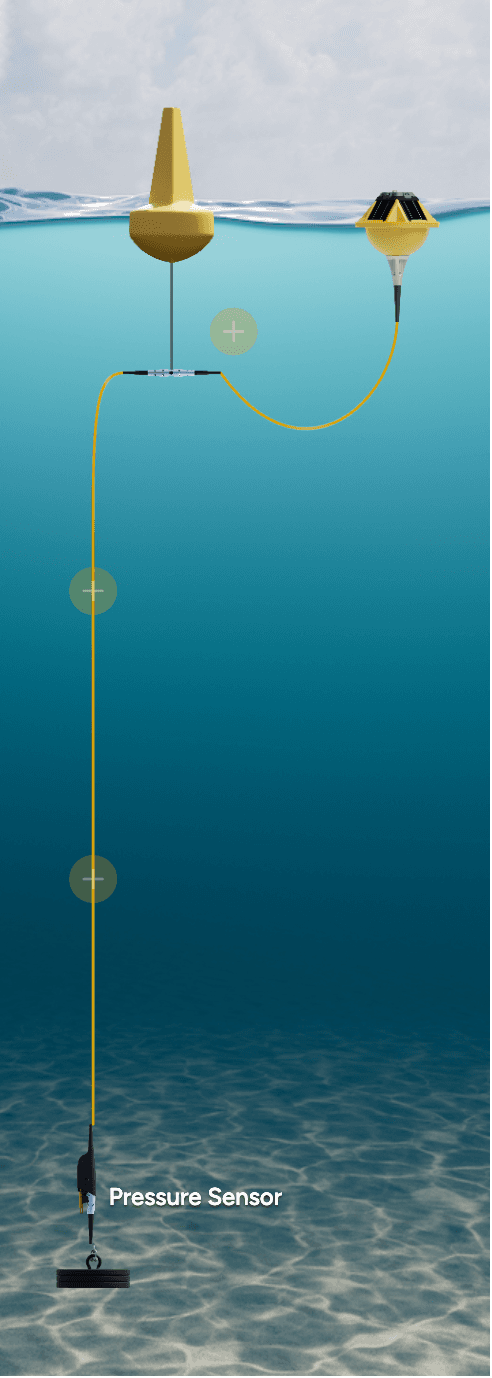
Because passenger safety demands precision at the actual gangway location, the monitoring approach positions sensors where vessels berth—not at the harbor entrance. A compact buoy system within the cruise terminal basin captures wave height, period, and direction as conditions exist where gangways deploy. Wind loads on high-sided cruise vessels affect stability independently of wave action[3].
What the Data Reveals
When a cruise vessel approaches its scheduled embarkation window, terminal operators see real-time conditions specific to that berth. The data reveals not just current wave height but whether conditions are stable, improving, or deteriorating, critical context for vessels with tight turnaround schedules. Because waves transform as they enter enclosed basins, berth measurements often show patterns that entrance monitoring misses entirely: reflected waves amplifying at certain periods, or surprisingly calm conditions[4] when outer harbor data suggests otherwise.
What This Enables
Terminal operators gain the information needed for defensible go/no-go decisions[5]. When conditions remain within gangway operation limits, embarkation proceeds on schedule with documented safety compliance. When conditions approach thresholds, automated alerts provide advance warning, enabling passenger communication before delays become apparent. Over time, this continuous record reveals patterns: which berths experience the most motion during certain wind directions, how seasonal wave climates affect scheduling, and which vessel types prove most sensitive to local conditions. This operational intelligence informs berth assignment and schedule planning, reducing the frequency of last-minute disruptions while maintaining the zero-incident standard passenger operations require.
Recommended Systems (2)
Because passenger gangway safety depends on conditions at the berth itself, the monitoring approach focuses sensing where vessels actually moor rather than distributing stations throughout the harbor. A single well-positioned system within the cruise basin captures the transformed wave conditions that determine vessel motion at berth. For terminals with multiple berths experiencing different exposure patterns, additional positions may be warranted.
System Overview
Purpose
Captures wave and wind conditions at the berth where gangway operations occur, enabling real-time go/no-go decisions for passenger embarkation.
Deployment Context
Positioned within the cruise terminal basin, oriented to capture wave conditions representative of the primary berth face.
Sensors
Required

Wave
Measures the wave height, period, and direction that drive vessel surge, sway, and heave, the primary determinants of gangway operation safety.
Wind
Captures wind speed and direction at berth level, critical because wind loads on high-sided cruise vessels affect motion independently of wave action.
Important
Current Meter
Monitors current velocity affecting vessel position at berth, particularly relevant during maneuvering and when mooring lines are under load.
Pressure (Depth)
Tracks tidal state affecting gangway angle. As water level changes, gangway slope shifts, influencing both safety and accessibility compliance.
Sources
- [1]Response-Based Forecasting of Vessel Motion: From Physics-Based to Data-Driven Methods— Doi
- [2]Minor Structures for the Improvement of Wave Disturbance in a ...— Wiley
- [3]Modeling and controller design of an offshore wind service operation vessel with parallel active motion compensated gangway— Doi
- [4]2D reflection seismic surveys to delineate manganese mineralisation beneath the thick Kalahari and Karoo cover in the Griqualand West Basin, South Africa— Doi
- [5]Enhancing Offshore Installation Decision-Making Through the Integrated Application of Vessel Motion Based Criteria (VMBC) Methodology and Digital Tools— Doi
Use of this content is subject to Sofar's Terms of Use and Privacy Policy.