Real-Time Cetacean Detection for Dynamic Vessel Management in Protected Waters
Continuous passive acoustic monitoring detects whale and dolphin vocalizations in real time, enabling dynamic vessel management responses
What You'll Achieve
Immediate Detection Alerts for Vessel Management
Receive automated notifications within minutes of cetacean vocalizations, enabling vessel slowdowns and route adjustments while animals remain in the area.
Species-Specific Identification Across Frequency Ranges
Distinguish between baleen whale calls, dolphin echolocation clicks, and other marine mammals to apply appropriate protection measures for each species.
Long-Term Acoustic Records for Protection Validation
Build continuous vocal activity datasets that document seasonal presence patterns, population trends, and the effectiveness of management interventions.
Static Protection Boundaries Cannot Track Moving Animals
Marine protected areas typically rely on fixed exclusion zones drawn around historically important habitat[1]. But whales and dolphins move constantly in response to prey availability, oceanographic conditions, and seasonal cycles. When animals shift outside established boundaries, they lose protection. When they're absent from protected waters, restrictions may unnecessarily constrain vessel traffic. Visual surveys that could track actual presence are weather-dependent, expensive to sustain, and limited to daylight hours when animals surface.
This creates a fundamental gap between where protection applies and where animals actually occur. Vessel operators lack real-time information about cetacean presence along their routes. Managers cannot demonstrate that protection measures are working without systematic detection records. Without continuous monitoring, sporadic survey data may miss entire population segments — deep-diving species that surface briefly, or animals vocalizing at night when observers are absent.
Continuous Acoustic Monitoring Enables Dynamic, Evidence-Based Protection
What Gets Deployed
Passive acoustic monitoring (PAM) stations positioned within protected waters listen continuously for cetacean vocalizations[2]. Because different species produce calls across vastly different frequency ranges — blue whales at 10-20 Hz, bottlenose dolphins at 20-150 kHz[3] — broadband hydrophones capture the full acoustic repertoire present in the area. Integrated environmental sensors track atmospheric and surface conditions affecting detection probability and animal behavior.
What the Data Reveals
When a whale begins calling or dolphins produce echolocation click trains, the acoustic station detects these signals against the ambient soundscape and generates alerts within minutes. Because detection probability varies with species, sea state, and background noise[4], environmental data helps managers interpret what absence of detections actually means — whether animals are likely absent or simply undetectable under current conditions. Automated classification routines identify species and estimate approximate bearing, providing vessel operators with actionable information rather than raw acoustic data requiring expert interpretation.
What This Enables
Real-time alerts transform static protection into dynamic management. When detections occur, vessel traffic control can implement slowdowns or recommend route adjustments for the specific area and duration of cetacean presence. This approach protects animals more effectively than fixed boundaries while reducing unnecessary restrictions when animals are elsewhere. Over months and seasons, the continuous acoustic record reveals presence patterns invisible to periodic surveys[5] — nighttime vocal activity, seasonal shifts in distribution, responses to environmental changes. These long-term datasets provide the evidence base that managers need to justify protection measures, adjust boundaries based on actual usage, and demonstrate to stakeholders that interventions produce measurable conservation outcomes.
Recommended Systems (2)
Because effective cetacean protection requires both real-time detection capability and environmental context for interpreting acoustic data, the recommended approach integrates passive acoustics with environmental sensors on a single platform. Subsurface temperature data tracks local conditions that influence sound speed and detection range, providing critical context for interpreting acoustic results. For larger protected areas, multiple acoustic stations may be needed to ensure adequate spatial coverage of key habitats and transit corridors.
System Overview
Purpose
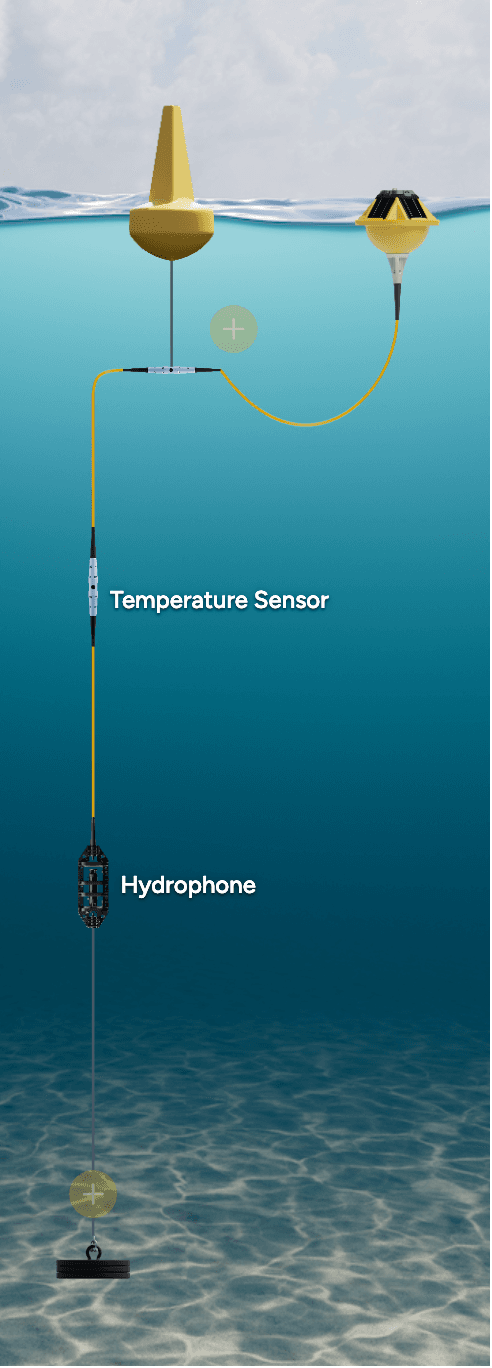
Continuous passive acoustic detection of cetacean vocalizations with real-time species identification and alert generation, supported by integrated environmental sensing.
Deployment Context
Positioned at depths appropriate for target species — deeper deployments improve detection range for low-frequency whale calls, while shallower positions suit high-frequency dolphin echolocation.
Sensors
Required
Hydrophone
Captures cetacean vocalizations across the frequency range of target species, from infrasonic whale calls to ultrasonic dolphin clicks.
Temperature (Water)
Tracks local sound speed at the detection depth, critical for interpreting detection range and acoustic data quality.
Important
Pressure (Depth)
Confirms sensor position in the water column and detects vertical movement that could affect acoustic detection geometry.
Wind
Tracks surface conditions directly affecting ambient noise levels and acoustic detection probability.
Sources
- [1]dynamic area-based management tools in a changing ocean— Frontiers
- [2]Using passive acoustic monitoring to investigate the ...— ScienceDirect
- [3]What are the frequency ranges of most marine mammal ...— Stackexchange
- [4]Matching visual and acoustic events to estimate detection ...— Frontiers
- [5]Cetacean distribution models based on visual and passive ...— Nature
Use of this content is subject to Sofar's Terms of Use and Privacy Policy.