Acoustic Vessel Surveillance for MPA Enforcement
Passive acoustic monitoring detects unauthorized vessel activity in protected waters, enabling 24/7 surveillance and evidence-based enforcement.

What You'll Achieve
Around-the-Clock Detection Coverage
Continuous acoustic surveillance captures vessel activity during nights, storms, and patrol gaps — when illegal incursions most often occur.
Evidence-Based Enforcement Action
Documented acoustic detections with timestamps and signature analysis provide the evidentiary foundation that enforcement proceedings require.
Strategic Patrol Optimization
Real-time alerts direct limited patrol resources toward confirmed intrusions rather than randomized sweeps across vast protected areas.
Protecting Waters You Cannot Watch
Marine protected areas often span hundreds or thousands of square kilometers, yet enforcement typically relies on patrol vessels that can only monitor a fraction of that area at any given time[1]. Illegal, Unreported, and Unregulated (IUU) fishing and unauthorized transit frequently occur at night, during rough weather, or in remote corners where patrols rarely venture. Without continuous surveillance, enforcement teams operate reactively — responding to reports rather than catching violations in progress.
Traditional monitoring approaches compound these coverage gaps. Vessel Monitoring Systems only track registered commercial vessels that choose compliance. Aerial surveys provide snapshots but cannot maintain persistent presence. Radar installations require substantial shore-based infrastructure that remote MPAs lack. Even when violations are witnessed, the absence of documented evidence often undermines enforcement action. Managers know illegal activity occurs but struggle to quantify compliance rates or demonstrate where resources should be concentrated.
Listening for Intrusions Across Protected Boundaries
What Gets Deployed
Because vessel engines produce distinctive underwater acoustic signatures[2], hydrophone networks positioned at strategic boundaries and high-value habitat areas can detect intrusions that visual surveillance would miss entirely. Engine noise propagates efficiently through water, allowing a single acoustic station to monitor approaches across several kilometers — coverage that would require constant patrol presence to achieve visually.
What the Data Reveals
When a vessel enters the detection zone, its engine signature registers against the ambient soundscape. Different vessel classes produce characteristic acoustic profiles[3]: small outboard motors generate high-frequency noise distinct from the low-frequency rumble of larger commercial engines. This acoustic fingerprinting enables approximate classification of vessel size and type, helping enforcement teams prioritize responses. Because the network operates continuously, it captures activity patterns that periodic patrols would struggle to observe — revealing which hours, tidal phases, or weather windows attract the most unauthorized traffic.
Over months of monitoring, these observations build into compliance portraits for different MPA zones. Managers see whether violations cluster near specific boundaries, whether certain seasons carry higher intrusion risk, and whether enforcement actions are producing measurable deterrence. The acoustic record becomes both an operational tool and a management archive, documenting protection effectiveness for reporting requirements and funding justifications.
What This Enables
Real-time detection alerts transform patrol strategy from randomized sweeps into targeted responses. When the network registers an intrusion, enforcement vessels can intercept while the violation is in progress rather than discovering evidence after the fact. Acoustic timestamps and signature data support formal proceedings when cases reach administrative or legal review[4]. For remote MPAs where patrol vessel time costs thousands of dollars per day, directing those resources toward confirmed activity rather than speculative coverage dramatically improves enforcement efficiency.
Recommended Systems (2)
Because acoustic detection range depends on both sensor positioning and local sound propagation conditions, the monitoring approach deploys listening stations at strategic chokepoints and high-value zones where intrusions carry the greatest ecological or regulatory consequence. Integrated environmental sensors — particularly subsurface temperature monitoring — provide the context needed to interpret detection performance, enabling operators to assess alert confidence under varying oceanographic conditions.
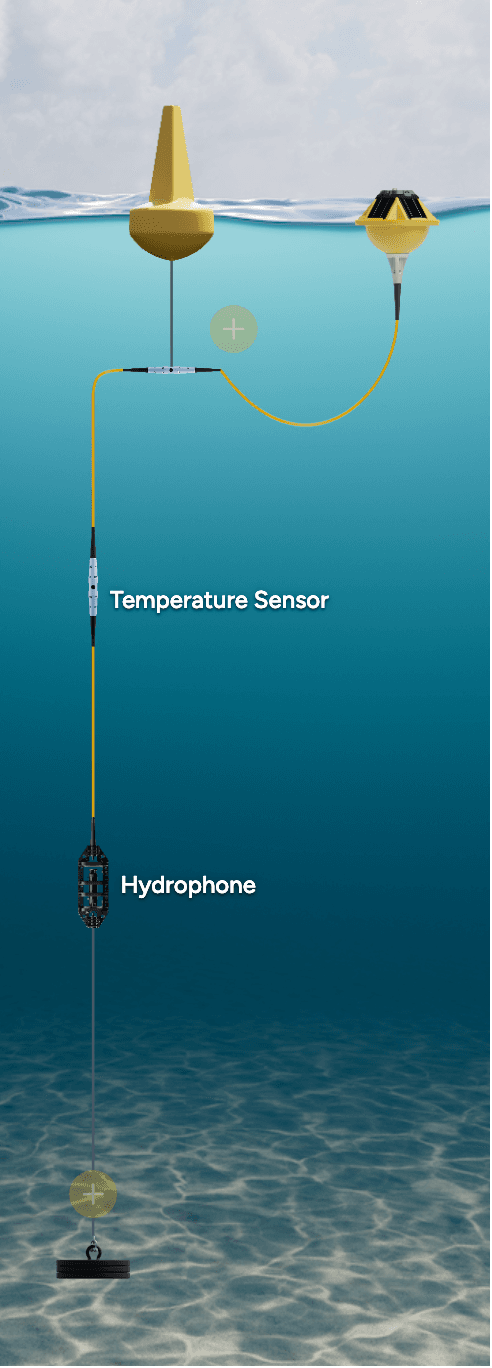
System Overview
Purpose
Continuous passive listening for vessel engine signatures across protected boundaries and high-value habitat zones
Deployment Context
Positioned at strategic boundary approaches, navigation chokepoints, or sensitive habitat areas where unauthorized vessel activity poses the greatest enforcement concern
Sensors
Required
Hydrophone
Detects engine noise across frequency ranges that distinguish vessel classes, providing timestamped detection records for enforcement documentation
Important
Temperature (Water)
Sound speed varies with temperature; thermal monitoring improves detection range estimation and reduces false alarm rates from propagation anomalies
Nice-to-have
Pressure (Depth)
Confirms mooring stability and deployment depth, supporting data quality assurance for acoustic detection records
Sources
- [1]The Use of Earth Observation Tools for the Surveillance and Enforcement of Marine Protected Areas on the High Seas— Doi
- [2]Acoustic signature— Wikipedia
- [3]An Investigation of Preprocessing Filters and Deep Learning Methods for Vessel Type Classification With Underwater Acoustic Data— Doi
- [4]Landmark Based Audio Fingerprinting for Naval Vessels— Ieee
Use of this content is subject to Sofar's Terms of Use and Privacy Policy.