Acoustic Ecosystem Health Assessment for Coral Reef Conservation
Continuous underwater acoustic monitoring reveals reef ecosystem health through biological soundscapes, detecting stress before visible decline.

What You'll Achieve
Document Ecosystem Health Through Soundscapes
Capture biological activity patterns through continuous acoustic monitoring, creating quantifiable baselines that visual surveys cannot detect.
Detect Stress Events Before Visible Decline
Detect behavioral responses to thermal stress as conditions approach bleaching thresholds, enabling intervention when corals can still recover.
Establish Recovery Trajectories for Restoration
Document how biological activity returns after disturbance, providing evidence of restoration success to justify conservation investment.
Reef Health Declines Before Visual Surveys Can Detect It
Coral reef ecosystems generate complex soundscapes — fish vocalizations during spawning, snapping shrimp creating ambient noise, parrotfish grazing on algae. When reefs experience stress, these biological sounds may diminish as organisms respond behaviorally to changing conditions. Traditional monitoring relies on periodic dive surveys that capture snapshots but miss the continuous patterns signaling ecosystem change.
Visual assessments require specialized expertise, favorable diving conditions, and significant vessel time. They document what has already happened — bleached coral, reduced fish abundance, algal overgrowth — but cannot reveal the behavioral changes embedded in daily acoustic patterns. Without continuous monitoring, conservation managers lack the real-time awareness needed to trigger adaptive responses when interventions are most effective.
Continuous Acoustic Monitoring Reveals What Visual Surveys Cannot Capture
What Gets Deployed
A distributed network of acoustic and environmental sensors captures the biological soundscapes that indicate ecosystem health. Hydrophones record reef sounds across the full frequency spectrum while temperature, current, and water quality sensors provide environmental context. Systems deploy across depth gradients and habitat types, creating spatial coverage that reveals how different reef zones respond to stress.
What the Data Reveals
Because the network operates continuously, it captures daily and seasonal patterns in biological activity that visual surveys miss. Dawn and dusk choruses intensify during spawning seasons. Snapping shrimp activity peaks during specific tidal phases. Parrotfish grazing sounds concentrate in healthy coral zones. As thermal stress accumulates, these patterns shift — vocalizations decrease, invertebrate sounds decline, and the acoustic signature of a healthy reef fades. Fish reduce calling activity, mobile species relocate to deeper refuges, and the soundscape becomes quieter and less diverse. These changes provide quantifiable signals that can trigger monitoring intensification and enable rapid assessment of stress severity across the protected area.
What This Enables
With continuous acoustic baselines established, conservation managers can detect anomalies through ongoing data streams rather than waiting for scheduled dive surveys. Earlier detection enables adaptive responses when corals are most likely to recover from stress. After disturbance events, the acoustic record documents recovery trajectories, showing when biological activity returns and how long restoration takes. This long-term proof demonstrates conservation effectiveness to funders, supports protected area designation, and informs adaptive management strategies that improve reef resilience.
Recommended Systems (2)
The monitoring approach combines complementary data streams to create a comprehensive picture of reef health. Reef-mounted acoustic stations document biological soundscapes and environmental conditions at multiple locations, while current profiling systems capture water movement patterns that influence larval connectivity and thermal stress. Together, these systems provide both the biological indicators and physical drivers of ecosystem change. Multiple acoustic stations positioned across habitat zones provide spatial coverage revealing how different reef areas respond to environmental change.
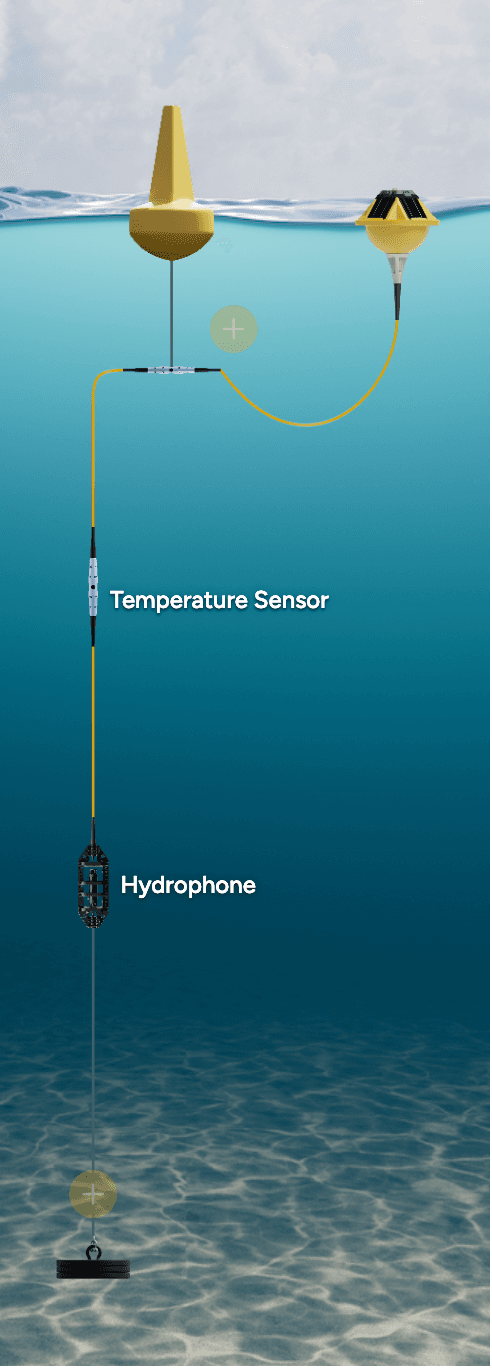
System Overview
Purpose
Captures biological soundscapes and environmental conditions that indicate reef ecosystem health
Deployment Context
Moored at representative locations across reef zones (shallow reef crest, mid-depth slope, deeper refugia). Multiple instances positioned across the monitoring area as needed for spatial coverage.
Sensors
Required
Hydrophone
Records full-spectrum reef sounds — fish vocalizations, invertebrate activity, ambient noise — that quantify biological activity and reveal stress-driven behavioral changes
Temperature
Tracks thermal stress accumulation that drives coral bleaching and explains acoustic pattern shifts as mobile species respond to warming
Important
Dissolved Oxygen
Captures hypoxic events that stress reef organisms and alter behavior, explaining acoustic anomalies during low-oxygen periods
pH
Documents ocean acidification impacts that affect calcifying organisms and correlate with long-term soundscape changes as species composition shifts
Use of this content is subject to Sofar's Terms of Use and Privacy Policy.