Long-Period Swell Monitoring for Berth Availability Forecasting
Detect incoming long-period swell before it triggers mooring line resonance, enabling proactive berth reassignments and tow tug standby decisions.

What You'll Achieve
Advance Warning of Resonance Conditions
Detect long-period swell energy hours before it triggers mooring issues, giving time for tug standby calls and berth reassignment decisions.
Prevention of Mooring Line Failures
Track vessel motion against ANSI and PIANL thresholds and mooring load limits, enabling intervention before lines approach dangerous tension levels.
Optimized Terminal Productivity
Maintain crane operations within efficiency thresholds by forecasting when berth conditions will exceed surge, sway, and roll limits.
When Calm Seas Snap Mooring Lines
Long-period swell presents a paradox that confounds visual assessment: the harbor surface appears calm while vessels at berth surge against their mooring lines with dangerous force. Swell periods exceeding 12 seconds can match the natural resonance frequencies of moored vessels and berth geometry[1], amplifying motion far beyond what wave height alone suggests. A 0.5-meter swell at 16 seconds can induce greater mooring loads than a 1.5-meter sea at 6 seconds. When vessel surge exceeds ±0.5 meters or roll exceeds ±0.5 degrees, crane operations halt—cell guides jam, spreakers swing, and moves per hour collapse. If motion continues unchecked, mooring lines approaching 55% of their Maximum Breaking Load (MBL) can part without warning[2].
Regional wave forecasts provide Hs and dominant period, but they cannot capture what happens when that energy enters a specific harbor. Breakwater gaps, basin dimensions, and berth orientation create resonance patterns unique to each port[3]. A swell that passes harmlessly through one terminal may amplify dramatically at a berth 500 meters away. Without local monitoring that tracks both incoming swell characteristics and actual berth response, harbor managers make assignments based on incomplete information—discovering problems only when lines strain and cranes stop.
Forecasting Berth Conditions Before Swell Arrives
What Gets the Deployed
Because the danger lies in the mismatch between incoming swell energy and harbor resonance, the monitoring approach positions wave sensors at two scales: offshore to detect approaching swell characteristics, and at berths to measure actual vessel response. Offshore wave monitoring captures period distributions and directional spectra before swell energy enters the harbor[4]—providing the early warning that regional forecasts cannot. Berth-level sensors then track how that energy translates into vessel motion at each specific location, building the relationship between offshore conditions and berth response that enables prediction.
What the Data Reveals
As distant storms generate swell, the energy arrives as a building sequence—longest periods first, with intensity increasing over hours as shorter-period components follow. An offshore wave sensor tracking this progression detects the signature of an approaching swell event well before conditions at the berth deteriorate: rising energy in the 12+ second band, shifting directional alignment toward harbor entrance angles, and steady intensification across successive measurement intervals. This evolving picture gives operations teams hours to prepare rather than minutes to react. Teams can position tugs for standby, notify terminals to complete vessel work before conditions peak, or reassign incoming vessels to berths with more favorable orientation to the arriving swell direction.
The continuous record from berth-level accelerometers reveals how each swell event translates through the harbor[5], showing which berths amplify specific period bands and approach angles. Over time this builds a site-specific understanding that sharpens forecasts—linking what the offshore sensor detects to what each berth will experience.
What This Enables
Because the network captures both the incoming threat and the berth-specific response, harbor managers can issue berth availability forecasts with confidence. Vessels approaching port receive updated berthing assignments based on predicted conditions at arrival time, not just current observations. When monitoring shows vessel motion approaching PIANC WG2 thresholds—surge nearing ±0.5 meters, roll approaching ±1 degree—terminals can make the decision to single up and shift berths before conditions force emergency response. Over seasons, the accumulated data reveals patterns: which swell directions and periods create problems at which berths, how quickly conditions typically build and subside, and where infrastructure modifications might reduce resonance effects.
Case Study
How real-time wave data replaced manual port closures at Chile's exposed oil terminals
A small Chilean marine engineering firm has grown from a single Spotter pilot to a six-buoy fleet supporting tanker mooring decisions at the terminals that keep the country's fuel moving.
See full example.jpg)
Recommended Systems (3)
Because effective prediction requires understanding both the incoming energy and the harbor's response, the monitoring approach positions wave sensors at the approach to detect swell characteristics and motion sensors at berths to measure how vessels actually respond. This separation provides the lead time needed for operational decisions while building the site-specific knowledge that improves forecasts over successive events. Ports with multiple terminals may require additional berth monitoring positions to capture variation across different basin geometries.
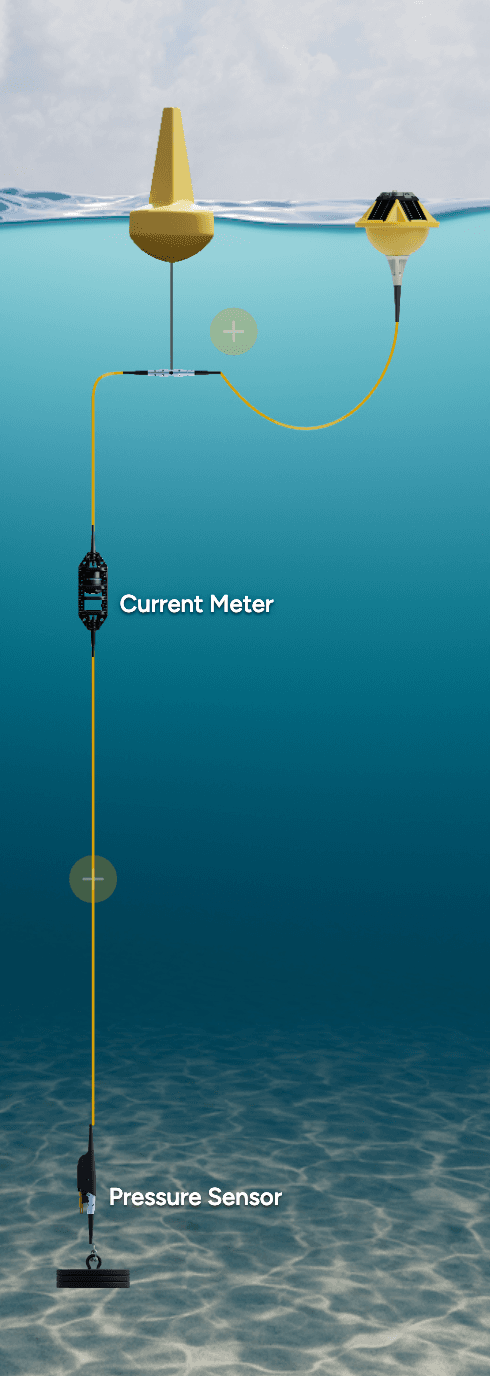
System Overview
Purpose
Detect long-period swell energy and directional characteristics before entering the harbor, providing advance warning for operational planning.
Deployment Context
Positioned seaward of the harbor entrance in sufficient depth to capture open-ocean swell characteristics before shoaling effects alter the wave field.
Sensors
Required

Wave
Captures full spectral analysis including period distributions, enabling identification of dangerous long-period energy bands (>12s) before arrival at berths.
Current Meter
Measures ambient current that combines with swell to affect vessel drift forces and mooring loads at berth.
Important
Pressure (Depth)
Provides tidal stage data essential for correlating swell penetration with water level conditions at harbor entrance.
Wind
Tracks wind-wave development and sustained wind forces that compound swell-induced vessel motion at berth.
Sources
- [1]Harbor resonance— Coastalwiki
- [2][PDF] Final Express Terms - California State lands Commission— Ca
- [3]Long period oscillations and tidal level in the Port of Ferrol— ScienceDirect
- [4][PDF] Harbor Hydrodynamics - PDH Online— Pdhonline
- [5]Characteristics of low-frequency motions of ships moored inside ...— ScienceDirect
Use of this content is subject to Sofar's Terms of Use and Privacy Policy.