Ambient Noise Assessment for Port Environmental Compliance
Continuous underwater acoustic monitoring documents baseline conditions and verifies construction noise stays within permit limits.
What You'll Achieve
Document Baseline Conditions Before Construction Begins
Establish defensible acoustic baseline data showing natural sound levels and existing anthropogenic noise before pile driving or dredging starts.
Verify Mitigation Measures Work in Real Time
Confirm that bubble curtains, soft start procedures, and other noise reduction measures achieve their intended sound level reductions during operations.
Maintain Continuous Compliance Records
Build an unbroken acoustic record that demonstrates permit adherence throughout construction, protecting against work stoppages and regulatory challenges.
Proving Construction Noise Stays Within Permit Limits
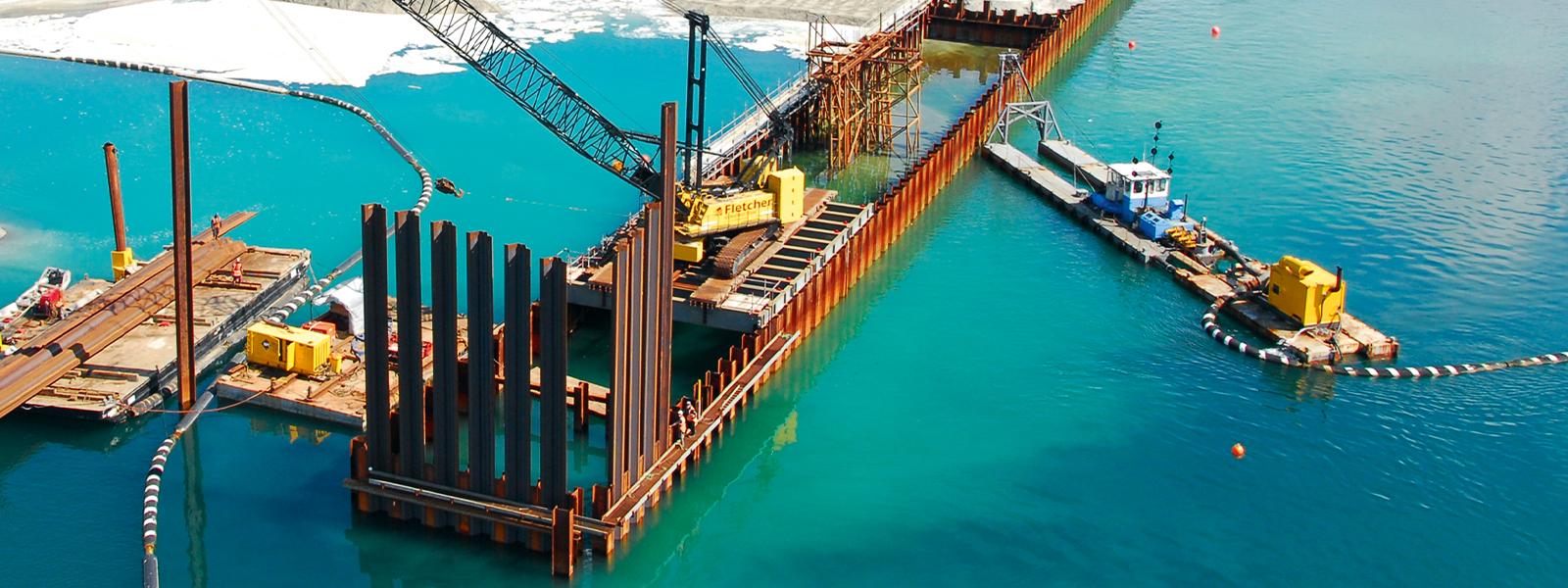
Port construction and maintenance activities generate substantial underwater noise. Pile driving, dredging operations, and heavy machinery create sound pressure levels that can exceed thresholds harmful to marine mammals and fish. Environmental permits increasingly require acoustic monitoring—both baseline assessments before work begins and continuous compliance verification during operations. Violating noise limits triggers work stoppages that cost tens of thousands per day in standby costs and schedule delays.
Traditional acoustic assessment relies on contracted surveys using specialized equipment and trained marine acousticians. These point-in-time measurements capture snapshots but miss temporal patterns—how noise varies with tidal cycles, weather conditions, and operational phases. Without continuous monitoring, construction managers cannot verify that mitigation measures like bubble curtains are actually achieving their intended reductions. When regulators question compliance, fragmented data leaves projects vulnerable to challenges that sustained real-time records would resolve.
Continuous Acoustic Monitoring That Documents What Regulations Require
What Gets Deployed
Each monitoring station combines acoustic measurement with the metocean context that affects it. The surface buoy captures wave conditions and wind speed, while a subsurface hydrophone measures sound pressure levels continuously in decibels referenced to 1 micropascal (dB re 1 μPa) across the frequency spectrum relevant to marine life. This co-location ensures tight correlation between environmental conditions and acoustic data at each position.
What the Data Reveals
Before construction begins, weeks of continuous recording establish baseline ambient noise—the natural soundscape plus existing vessel traffic, distant industrial sources, and biological sounds. This baseline becomes the reference point against which construction impacts are measured. As pile driving or dredging operations commence, real-time data shows how sound levels change with each activity phase. Construction managers see immediately whether a bubble curtain deployment achieved the expected 10-15 dB reduction, or whether soft start procedures are ramping energy appropriately before full-power driving begins.
The acoustic record captures patterns that point-in-time surveys miss entirely. Sound propagation changes with water temperature profiles, with tidal flows, with weather conditions. Integrated metocean measurements from the same location enable direct correlation—explaining why ambient noise increased during a storm event or how temperature stratification affected sound propagation on a particular day.
What This Enables
When questions arise about permit compliance, the continuous record provides evidence that traditional surveys cannot match. Rather than defending isolated measurements, project teams can demonstrate sustained adherence across all operating conditions. Mitigation effectiveness becomes measurable: before-and-after comparisons show exactly what each intervention achieved. This documentation protects against work stoppages triggered by unsubstantiated complaints, and positions projects favorably for future permit applications by demonstrating a track record of acoustic management.
Recommended System
Because acoustic compliance requires both sound measurement and environmental context, each station captures co-located acoustic and metocean data. The surface buoy measures wave and wind conditions that contribute to ambient noise, while the subsurface hydrophone records the acoustic data regulators require. This co-location provides the tight correlation needed to explain how environmental factors influence measurements. For construction projects spanning large areas, multiple stations may be needed to characterize spatial variation in noise exposure.
Integrated Acoustic Monitoring Station
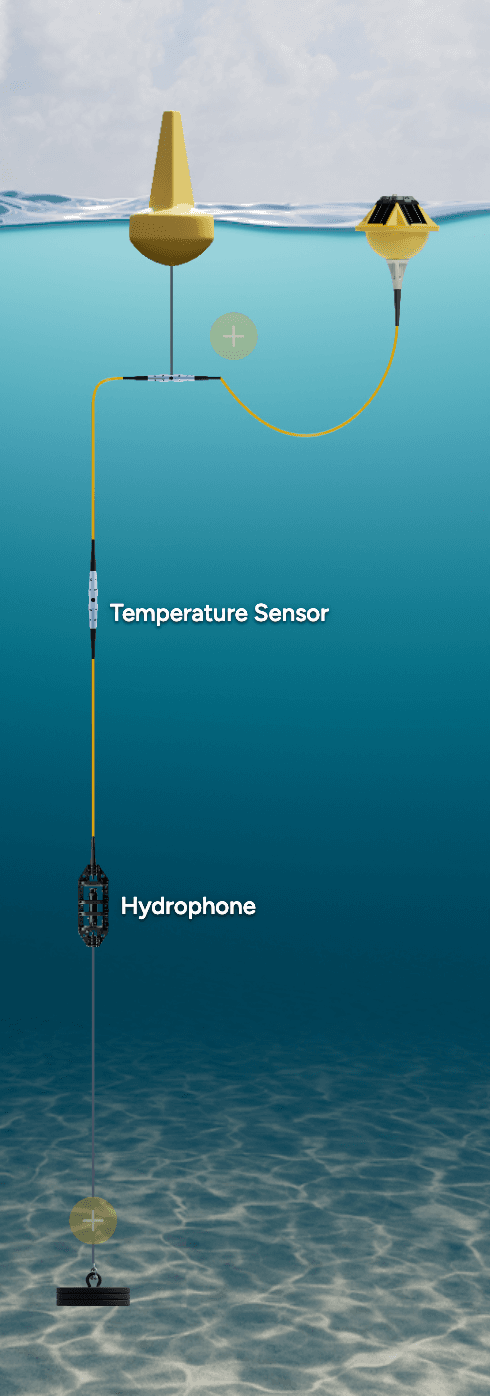
System Overview
Purpose
Continuous measurement of underwater sound pressure levels with co-located environmental context for baseline documentation and construction compliance verification
Deployment Context
Positioned at representative distance from construction activities, within the permit-defined monitoring zone
Sensors
Required
Hydrophone
Captures underwater sound pressure levels (dB re 1 μPa) and frequency spectrum essential for permit compliance and marine mammal impact assessment
Important

Wave
Sea state affects surface-generated ambient noise that forms part of the acoustic baseline; also determines construction weather windows
Wind
Wind-driven surface agitation contributes to ambient noise levels; enables correlation between weather events and acoustic measurements
Temperature (Water)
Sound speed varies with temperature, affecting propagation calculations and enabling correction of acoustic measurements to standard conditions
Use of this content is subject to Sofar's Terms of Use and Privacy Policy.